

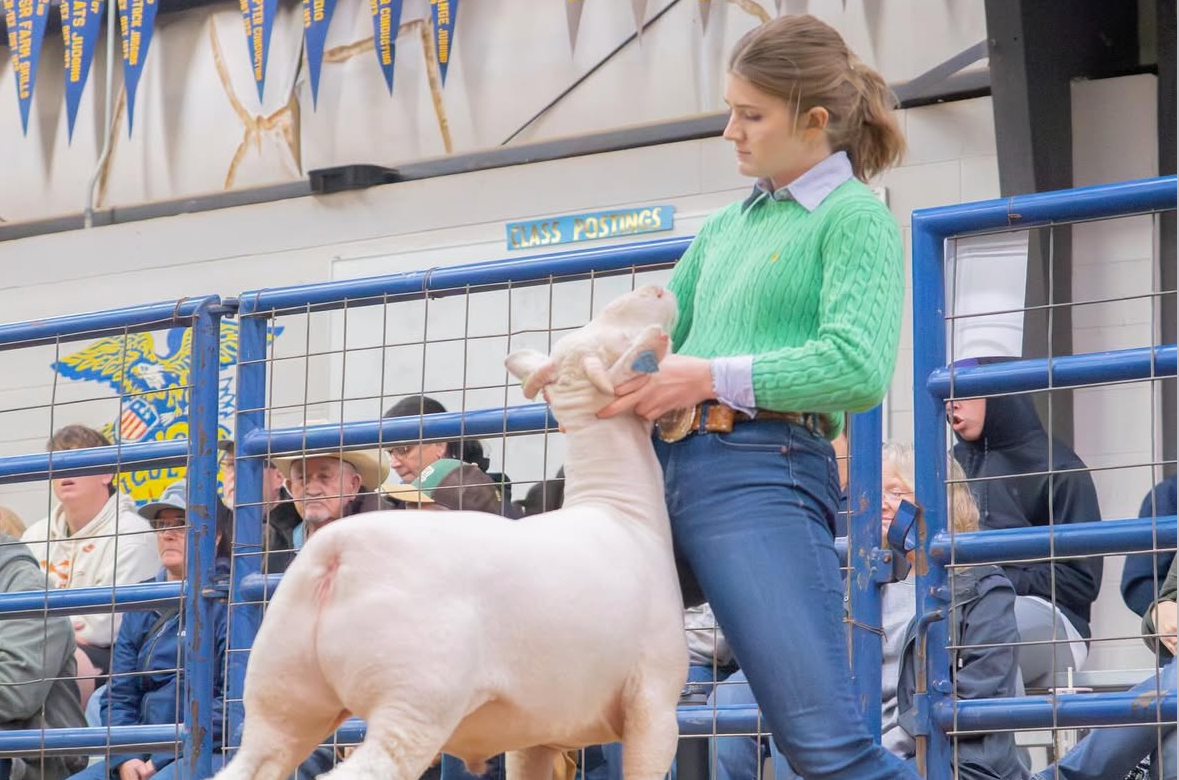
It only takes a girl, a pig and a lamb to create a champion.
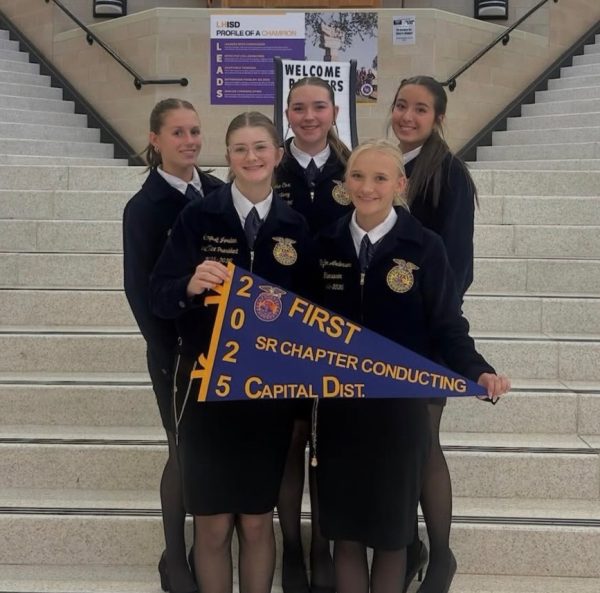
Senior Campbell Jordan serves as the president of the school’s FFA chapter, as well as the first vice president for Area XII. After four years of taking agriculture classes, she plans to pursue a career in either animal genetics or nutrition after attending Texas A&M University.
“FFA is really what’s given me an idea for what I want to do,” Jordan said. “It’s made my goals a lot more tangible. A lot of kids just want to be a vet because ‘oh, I have a dog,’ and they like the idea of animals, but you really don’t understand what it entails until you’re in the thick of it.”
Jordan first found interest in the organization in eighth grade, when her brother, who was on the vet science team at the time, inspired her to join. She made the team as a freshman and competed in vet science events for her first two years of high school, advancing to nationals her sophomore year.
“Campbell has done a great job in the ag department and FFA over the years,” Magan Escamilla, veterinary sciences teacher and FFA sponsor, said. “While she has lots of things I can be proud of as an ag. teacher, I am most proud of her accomplishment of being a member of the state champion vet science team in 2024 and being able to represent Texas at the national level. Being able to walk the Lucas Oil stadium stage and securing third place in the country is just something I will never ever forget. I’m proud of all the work she did at home daily to help get us there.”
In vet science, 750 of 1,000 total points come from the contestants’ abilities to identify breeds, species, parasites and more, as well as the different tools one would use in a vet practice. The other sections of the competition include a test over chapters of a vet textbook, a math portion for dosage and dilution calculations and students’ performances of a certain list of skills used in a vet practice, such as prescription filling.
“I came in saying, ‘OK, I’m doing vet science,’ because that’s all my brother did, and my ag. teacher said, ‘You think that’s all you’re doing? You’re crazy,’” Jordan said. “So, [during] my freshman year, I got put into junior prepared public speaking, and speaking is still one of my favorite contests.”
For FFA events, after advancing to the national level for a Career Development Event (CDE), the student is not permitted to compete for it again. Now, Jordan competes in the Environmental & Natural Resources contest and shows livestock. Jordan competes with her lamb, Kermit, and her Yorkshire pig, Miss Piggy.
“Watching Campbell in the show ring is truly awe-inspiring,” Jordan’s mom Jennifer Boyle said. “Seeing the countless hours she spent working with her animals pay off, along with the poise and confidence she demonstrates while showing her [animals], is incredible. Watching my little girl confidently handle and direct hundreds of pounds of livestock as if it were the simplest task is something I’ll never forget.”
The goal of showing livestock is to see which animal will result in the best quality meat. In order to ensure they have enough muscle and marbling, the students exercise, feed and take care of their animals until their last competitions by visiting the barn twice a day.
“When the judges put their hands on the animal, you want them to feel really firm,” Jordan said. “It’s not just feeding them whatever either; it’s adjusting the food based on your wanted result, so maybe it’s raising protein, raising fat, whatever the animal needs. You make them the best they can possibly be in hopes of them placing well and ultimately being a good meat product.”
Being allergic to “most barn-related things,” including hay, goats, cattle and horses, Jordan chose to show pigs and lambs. On average, Jordan spends about two hours with her lamb, practicing showing him in the arena, exercising him on the treadmill and taking care of his hair. For Miss Piggy, Jordan walks her, cleans her pen, and washes her every other day.
“It’s really cool because each animal needs different treatment, so it’s up to you to figure out how to best treat them,” Jordan said. “I like taking care of my lamb’s leg hair because it just makes them look pretty.”
Both pigs and lambs are classified by breed. At the recent Greater Leander FFA lamb show on Jan. 23, Jordan was crowned the champion finewool, champion lamb showman and received the reserve overall lamb award, with the swine competition following on Jan. 28, where she won champion Yorkshire.
“The phrase ‘practice makes perfect’ is pretty applicable to [Jordan’s] FFA experience because she has worked extremely hard to earn the accolades that she has received,” floral design teacher Shannon Tidwell said. “I admire Campbell’s growth through this organization and her willingness to try new things. Campbell is a very different individual now as a senior than when she was as a freshman, largely due to her stepping out of her comfort zone through various FFA experiences and competitions.”
Jordan takes the vet practicum class, and she interns every other day at Bee Cave Veterinary Clinic. In order to enroll in this class, students must take the prerequisites from sophomore year and gain an internship at a local clinic that is willing to host and teach the student throughout the school year. Students must have 300 hours of supervision by a DVM and demonstrate proficiency in over 70 skills before they are allowed to take the certification test from the Texas Veterinary Medical Association at the end of the year.
“As an intern in the experience, it’s clear that she cares and really immerses herself into the experience every day,” Escamilla said. “To be successful as a student, I think it’s really important to be engaged in the process, not just the goal. Great students, Campbell included, remind you as a teacher that your work matters and that maybe your role helps shape them in some way. My hope is that not only do I notice that potential, but I help cultivate it in some way and make students truly believe that they are capable of things that don’t come easy.”
For Jordan, competitions are only part of her responsibilities for FFA. As an area officer, she attended the state leadership conference, then led a leadership conference for the district officers, as well as a Greenhand leadership conference for all first-year members to further involve them in the organization. In order to enroll in FFA, a student must also be taking an agriculture course.
“100% put the ag. class on your selection sheet,” Jordan said. “Our teachers pour their all into each of the teams and that’s a huge part of our success at competitions. You want to do anything, like run for an officer position or try a new contest, and it’s ‘How can I help? What can I do to set you up for success?’ They’re always so incredibly supportive, and I really don’t think that I would be where I am today at all without those four teachers.”
Her teachers aided Jordan in applying for officer roles throughout her high school career. As the first vice president of Area Xll, Jordan is the second-highest ranking officer in the area.
“As an area officer, a big part of my role is making sure everyone gets a full picture,” Jordan said. “If you want to succeed, anything you want to do, we will make sure you have that opportunity and the resources you need to do well. Agriculture is all about connectivity; a herd of cattle needs vets, and good cattle results in good meat, which is our food. It’s so much more than just traditional farming, and without it, we have nothing. FFA is all about giving kids the opportunity to be involved in every part of agriculture.”