
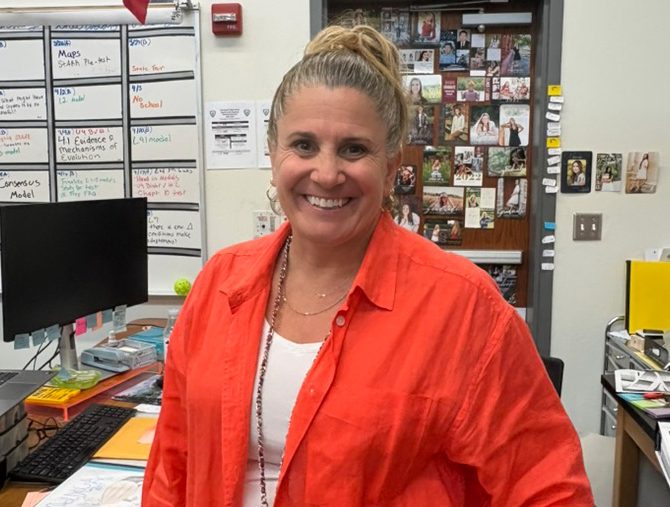
Third graders tremble in fear as their teacher prepares them to read out loud so she can sort them into reading groups. Placing students in group one signals their advanced comprehension, while group three is clearly intended for the individuals with room for growth. As one student approaches her turn, she attempts to replicate her prodigal friends’ fast reading in order to join them in group one. She fails, and the teacher places her in group three. Discouraged by the disbelief of her instructor, the girl begins to assume the class clown act, thinking she could be known as funny if she’s not smart.
When the girl moves to a new town and her teacher challenges her misbehaving act, she reiterates what her previous teacher had said about her: she’s dumb. When she arrived at school the next day, her new teacher placed “A Wrinkle in Time” on her desk — the book that the girl’s old teacher said she wasn’t advanced enough to read — signifying that they would read the book together. That day, Justyne Biddle decided that she knew what she wanted to do with her life — inspire and transform a student in the exact same way that teacher did for her.
“When she did that, I was like ‘Oh my gosh,’” now biology teacher Justyne Biddle said. “I went to tell my dad about it, and he said ‘That’s what good teachers do.’ That’s when I decided I wanted to be a teacher one day.”
Once in middle school, Biddle made it to regionals in her school science fair, indicating to her that she was particularly gifted at science. As a teenager, Biddle had the same teacher for all of her high school science classes: biology, chemistry, physics and AP Biology. In college, she pursued a scientific track.
“I still don’t know how I got to regionals because I can still tell you very little about my project, but I did,” Biddle said. “It was such a small school that I had the same teacher for all of my science classes. I just really liked him, so I ended up getting my degree in biology.”
Originally planning to attend a six-year program to pursue her teaching certificate at the University of Colorado Boulder, Biddle was quickly sidetracked when her parents, who resided in Austin, told her of the need for teachers in their city. Seizing the opportunity, Biddle obtained an alternative certification so she could start teaching immediately and get paid while acquiring her degree. At a job fair, Biddle was interviewed by the principal of Leander Middle School.
“He asked me what I thought of not letting the students see me smile the first semester, and I blew raspberries,” Biddle said. “I think he thought that was very funny, so he hired me. Thinking back, I don’t know — I probably shouldn’t have spit at someone in an interview, but I did.”
After working at Leander for four or five years, Biddle began working at Running Brushy when the middle school opened. One of her friends who taught at Hudson Bend Middle School connected her with principal Charlie Little. When Canyon Ridge Middle School opened up, Biddle was already living in Steiner and capitalized on the opportunity to work there. After about 15 years, Little offered her a job at the high school, and she took it.
“I think in all my years of teaching, something I’ve learned is that an important aspect of teaching is just knowing that balance of emotional growth and academic growth,” Biddle said. “I think just being a mom, I know where the kids are emotionally and academically, and then I find the balance between the two.”
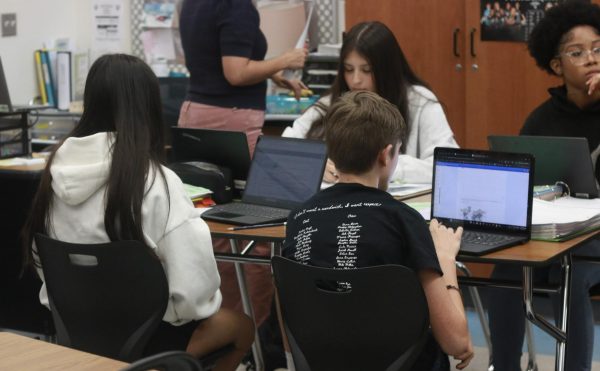
Biddle describes her teaching methods as immersive, encouraging participation among all students and inviting potential mistakes.
“I think some kids come in with the science block, like they’re afraid to take the risks,” Biddle said. “They don’t want to speak unless they’re saying the right thing. That’s a mistake because it’s better to make those guesses and let the teacher know what you’re thinking so that we can adjust accordingly. But when you try to hide, we don’t know what you understand exactly, so we just keep going, and we can’t address the misconceptions.”
According to Biddle, the new biology curriculum strives to inspire student introspection among themselves and conversations with their peers, instead of spoon-feeding answers and strict methodology.
“It’s a really fine line between feeling the confidence in yourself that you’ve given them the right answers and also giving them the space to process,” Biddle said. “I try to ride it, but I don’t know if I do it exceptionally well. This new curriculum has made it very clear that I had to give the students more space to discuss with each other and not give them the answers too fast.”
Shifts in education from student memorization of foundational knowledge to the computerization of basics highly affected Biddle in the classroom. Early schooling without modern devices stressed the importance of memorizing basic principles, while contemporary technology enables students to omit learning foundational information since it’s easily accessible online.
“It’s a mistake [to substitute student memorization for computer knowledge],” Biddle said. “I’m done with technology. I think that the time it takes students to write things down lets their brains catch up. With the computer, everything’s too fast.”
According to Biddle, she struggles with adapting classroom methods to incorporate and effectively utilize technology. She discludes devices in the tools she uses for learning in the classroom. Another deviation from typical teaching includes her abandonment of the notes-taking process, preferring to read and annotate actual scientific articles. She prioritizes hands-on learning, trying to make her students grasp the concept before giving them the vocabulary word to describe it.
“I used to do it the other way around, giving them the vocab word and then teaching the definition,” Biddle said. “Now, I try to get them to understand what’s happening first, and then give them the word for the process. Then, after I feel like they have a firm grasp on these ideas and words, I ask them to put in a drawing, like making a model to encapsulate what they were just taught.”
In biology, tests consists of a multiple-choice question portion (MCQ) and free-response question portion (FRQ). During FRQs, students draft up visual representations of scientific concepts to illustrate components of what they are taught. They do this using a multitude of colors, keys and the creativity of their minds. The outcome will demonstrate how well they understood the ideas they’ve learned.
“I love it when I see them do a model that’s not like mine,” Biddle said. “I’m just like ‘Oh my gosh, I like yours more!’ There’s been a lot of that lately. I’m like ‘That’s it, that’s better than the one I gave you. Yours is now the key!’ Or when they ask questions and I’m like ‘Yeah, that’s where we’re going next.’ That’s when I realize they’re really with me and they’re really comprehending it.”