

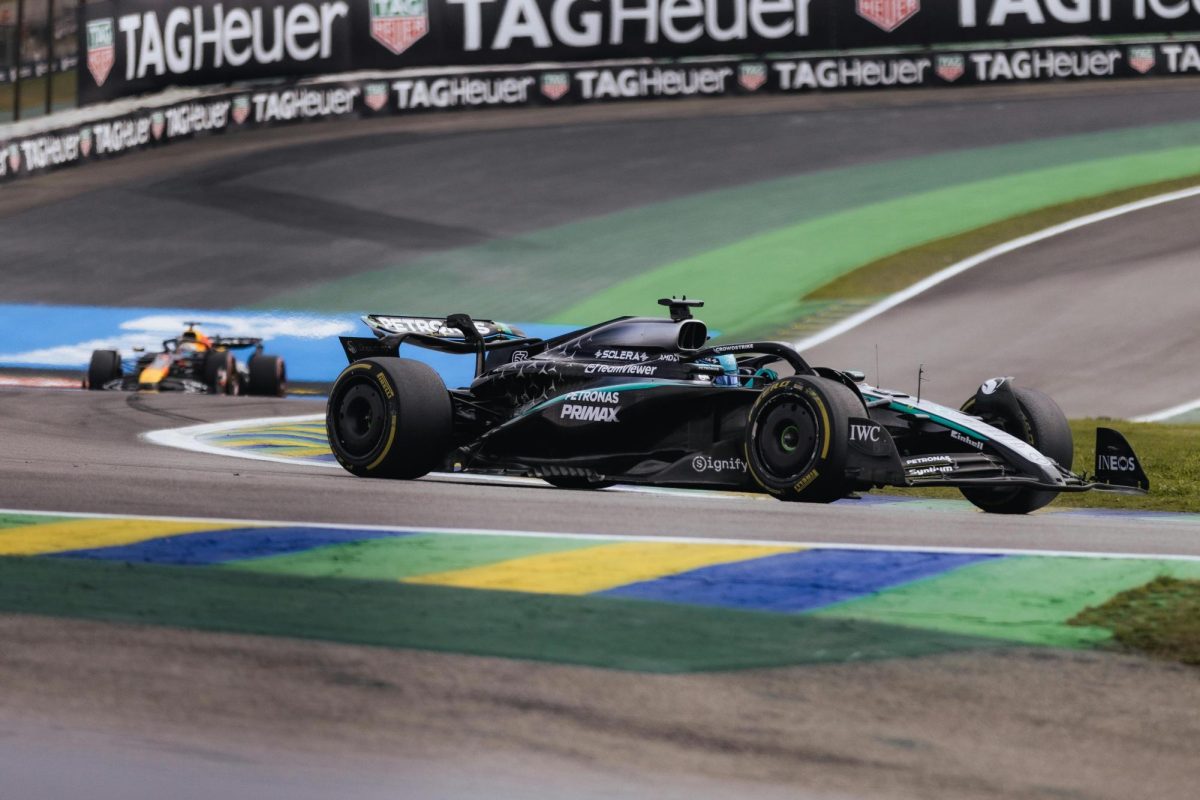
Vroom, vroom.
Containing an engine to rival NASA rockets, one of the most powerful machines in the world zooms down the straightaway at 200 mph. Deploying stored energy, the fanatic racer activates front and rear wings at specific angles to reduce air drag. This meticulous action, coupled with the energy exertion and nice slipstream they’re picking up from behind the race leader, gives them just enough power to burst ahead of the car.
Timing it perfectly, the Mercedes slips out from behind the car to accelerate just enough to jump ahead of them. With the biggest obstacle between him and his first Grand Prix win conquered, Andrea Kimi Antonelli celebrates internally while maintaining outward focus, recharging his car battery and settling in for the rest of his journey.
54 laps later, the youngest-ever pole sitter and Mercedes driver takes the checkered flag, becoming the second youngest Grand Prix winner of all time. The crowd erupts in jubilance. Ecstatic, he screams with joy when he finishes the race, marveling at his historic achievement: 19-year-old Antonelli won the gold in Formula One for the first time in his life. As the first Italian winner in the sport for 20 years, feelings of exultation at his momentous accomplishment overwhelm him. However, this isn’t just Antonelli’s day to celebrate — it establishes a recurring pattern of Mercedes success that will reward the team greatly as the season progresses.
Counted as one of the traditionally most exceptional teams in Formula 1, Mercedes exudes a confidence in their evidently superior car that foreshadows their inevitable victories in races to come — ideally, with this success prevailing in order to secure the constructors’ championship.

Last year, McLaren swooped the competition in constructors’ with a whopping 833 points. Mercedes concluded with a respectable second, but trailed McLaren with a comparatively measly 469 points. There lies incredible room for improvement within this huge deficit. Essentially, pretty much no F1 team remains comfortable with anything less than first. The higher they achieve, the more they want. All teams strive to become the very best. Once they’re there, they’ll do anything to avoid being dethroned.
In terms of the drivers’ championship, Max Verstappen almost reclaimed the win for the fifth consecutive time in his career, but lost out on it by two points to Lando Norris in the McLaren. If you want to track the exact evolution of the driver’s championship, you can visit my interactive map that depicts the results of each race when you hover over a marked location. The championship was a riveting battle that went down to the last Grand Prix: Abu Dhabi. Verstappen won the race, yet Norris obtained third place, which gave him a crucial 15 points to tip the scales, and allowed him to take home the biggest trophy.
However, with the extreme FIA regulation changes, most significantly the elimination of the Drag Reduction System (DRS), team and driver dominance can change overnight.
And it did.
Instead of remaining out of contention for constructors’ champion, Mercedes has embarked upon a series of consecutive victories, placing them in an idyllic position from the start. Through a combination of car and team excellence, they look fit to win the constructors’ and drivers’ championships.
Naturally, some might declare this claim far too premature three races into a 22-race competition. An understandable objection, seeing as F1 fame stems from their signature quick turning tables and last-minute, transformational results. Perhaps the sport’s popularity comes from its unpredictability, with startling changes evoking such strong emotion in their fans. Truly, a loyal watcher knows that entire championships can turn on a dime. Because so many complex factors come together to create one (hopefully) cohesive product, any one of these variables can go awry at any time, leaving anyone on teams of more than 1,000 at fault.

Yet despite these variants, Mercedes’ clear-cut supremacy in all aspects of the competition stands as an indisputable fact.
Firstly, their astonishingly powerful car contains an engine unrivaled by any other on the grid, with only a few minor weaknesses. These inadequacies don’t weigh too greatly in race results; the car still routinely delivers one-two wins for the team (a one-two is when both the drivers of the team earn first and second, therefore obtaining the highest amount of points for their team in one race). Once the season begins, there’s really not much that can interfere with the structure and engineering of the car to alter the performance, unless a team decides to implement some radical change in some sort of Hail Mary effort — something Mercedes likely wouldn’t opt for at this stage. Why tamper with perfection?
While the Ferrari specializes in quicker starts and acceleration, with particular strength around the curves, Mercedes is overwhelmingly more aerodynamic, better with tire management and has greater consistency with race pace. Their ability to overtake on straights or wing-enabled zones far exceeds Ferrari’s, or any other car on the track for that matter.

Apart from obvious car superiority, the Mercedes strategic team has a more flawless operation than Ferrari’s. The strategic team’s great control and understanding of their systems leads to Mercedes’ successful tire endurance and consistent race-pace optimization. The team also responds to situations of crisis with calm calculation, as opposed to Ferrari’s traditionally inconsistent, panic-driven calls.
Then there’s the matter of the drivers. Antonelli, who has proven his prodigious skill time and time again, alongside senior lead driver George Russell, the heavy preseason favorite to win the drivers’ championship.
Antonelli made waves in the F1 world when team principal Toto Wolff selected him to replace the seven-time world champion, Lewis Hamilton. Becoming the youngest ever Mercedes driver, the young Italian faced his fair share of criticism in the beginning of the season. He responded to the hate by breaking numerous records and attaining three poles, achieving an incredible debut season for any rookie, especially a teenager without a driver’s license.
This season, Antonelli won two out of the three races in the season so far, surpassing Russell by nine points in the collective championship after the Japanese Grand Prix. Thus, he continues his streak of unprecedented record breaking by becoming the youngest-ever drivers’ championship leader.
I consider Antonelli to be among the best on the grid, inferior only to the unfortunately restricted Verstappen — a sensational talent stuck driving that tractor of a Red Bull. In my opinion, Antonelli’s also on par with the Charles Leclerc and Oscar Piastri, some of the best drivers in the field currently. While Antonelli’s precocious talent counts him as one of the best, Russell’s seven years in F1 and steady showcase of decent results also makes him a fierce competitor for the world title. Your champion prediction just depends on if you value stable, considerable experience over overwhelming natural aptitude.
Regardless, with two of the best drivers on the grid, excellent engineers and a surpassing strategic team, Mercedes appears set to win all the titles Formula One has to offer this year. Arguably, I don’t believe a revolutionizing change can come to deter Mercedes from their winning spree. Their objectively superior car sets them up for incredible success. That said, F1 is a sport constantly subject to rapid and abrupt change. Viewers’ lack of precise knowledge of all of the mechanics and engineering forces them to draw conclusions from limited information. Therefore, I can’t proclaim my opinion with doubtless certainty, yet I can make a solid argument about Mercedes’ unparalleled success that currently dominates our screens, and predict an incredible season for the silver and teal.