
Juniors Ana Bolshakova, Aanya Eledath, Trisha Gupta, and Judy Song became the school’s first ever participants in the Wharton Global High School Investment Competition. As of Jan. 27, they advanced to the semifinals, placing in the top 50 out of 7,000 teams worldwide. These students submitted a final investment portfolio describing their 10-week investment strategy to potentially proceed to the final round: an in-person convention for the top 10 global teams. This conference will consist of a financial education day and a finale to announce the winning group, taking place at the Wharton School of the University of Pennsylvania on April 24-25. As of late March, they were selected for finalists, and will go forward in this competition.
“I found out about this competition, and I knew a group of really smart girls,” Bolshakova said. “This year actually one of the girls in the group went to ICDC, which is the world competition for DECA, so they’re very talented in business. And I was like, for sure, these people are great. They didn’t have investment experience, so we spent the first couple of months learning. Over time, we just accumulated this knowledge, and we were able to compete.”
Bolshakova’s group counts as the school’s first entry in this competition. Bolshakova had the idea to compete in early summer and soon compiled a team. Additionally, students who want to participate must register under a club. These girls competed through the economics club, hosted by their official advisor, Leslie Giesenschlag.
“We had a pretty knowledgeable mentor,” Gupta said. “Ana’s dad is an investment banker, and Ms. G (Giesenschlag) knew a lot of stuff too. But we did put a lot of time into it. We were doing maybe three to four hours every week on this project, potentially more. So it was difficult because we put a lot of time into it, but we had a good teacher.”
Before researching the client or executing a trade, they met up every Friday to learn more about general investing and fundamental information necessary for competing.
“Each of us made slide decks based on topics that we were learning so we could teach each other about the concepts,” Eledath said. “My and Trisha’s job was collecting data to give to Ana and Judy so they could put it into a simulation. Judy and Ana were the ones who were doing most of the coding. Then, we had to make our midterm report, which was basically just describing our process.”
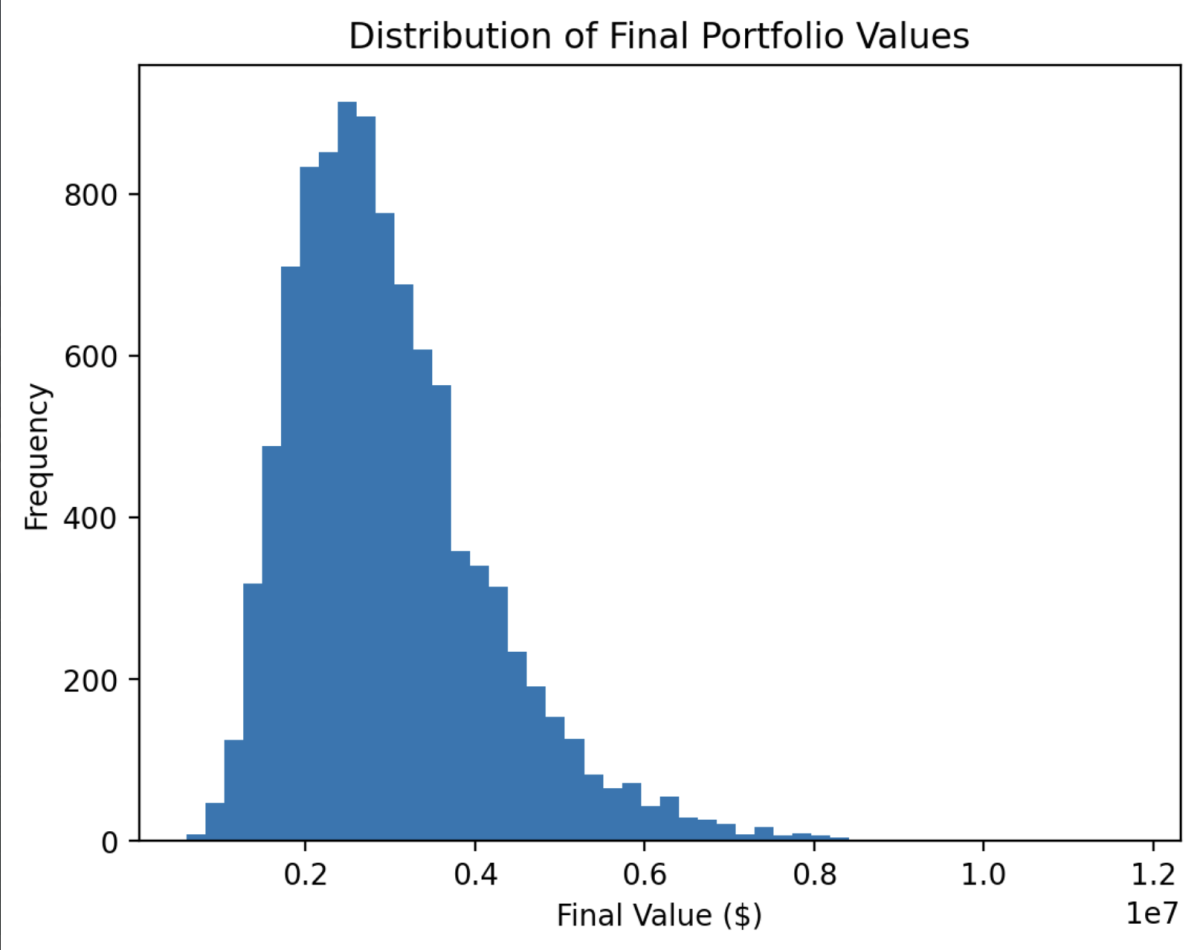
According to Gupta, their main task was filtering thousands of stocks by certain metrics, including market cap, amount of volatility, how much they would fluctuate, and more. They’d filter the approximate 2,000 stocks they had, and the remaining 200 would be inputted in a Monte Carlo system.
“We also handpicked stocks based on what the prompt wanted,” Gupta said. “After we went through all that, we ran a bunch of simulations just trying to get the best portfolio.”
The entire competition structures around student groups formulating an investment plan for a designated client and their business. All participants have the same client; this year, the client was former Philadelphia Eagles linebacker Connor Barwin, working with his charity, the Make The World Better Foundation. This nonprofit organization focuses on revamping local infrastructure, such as playgrounds and parks, to revitalize and strengthen communities.
“I want to make it clear that the idea isn’t to get the biggest return — it’s to make sure that you have a portfolio that fits Connor’s specific goals,” Bolshakova said. “For example, you can invest all in crypto, and you can get maybe a 200% return, but that comes with a lot of volatility. A lot of volatility is not suited for someone like him because he has a volunteering foundation. Rather, we needed something that would both get him his goals of 150% return, as well as being non-volatile, because we need to make sure we get him his money without having it lost randomly.”
As well as the organization’s goals, their client’s background and interests held great importance when devising their strategy.
“He’s a former NFL player, so he’s big into sports,” Bolshakova said. “So, that’s another thing that we considered whenever we were making our portfolio. We have a couple of sports and health entailed names, Nike being one of them. And then we have a couple of ETFs in the health sector.”
Their midterm portfolio, due on Oct. 31, comprised an eight-page depiction of their investment philosophy, its connection to the client, and the struggles and learning curves of their endeavors.
“We don’t really connect with other groups that much, but for semifinals we had to collaborate with another group,” Eledath said. “Their group was from London. It was fun talking to them and connecting with people from around the world.”
From there, teams put forth a final portfolio composed of their 20 stocks and ETFs, as well as a final 15-page paper. After both the midterm and final are submitted, they find out if they made the semifinals. If so, they make a 10-minute video presentation directly for the client, present their strategies to a panel of judges at the virtual semifinals, who in turn ask five specific questions about their portfolio, and participants will write a short answer response in order to qualify for top 10.
“It wasn’t just difficult because of what we had to do,” Bolshakova said. “Of course I chose these people because they’re very smart. And when you’re very smart, you apply yourself to so many different things, so time allocation was a really big thing, for all of us.”
Participants found out if they made the finalists sometime during March. Finalists will advance to the final stage of this competition — their first in-person congregation in Philadelphia. There, a winning team will be selected based off of a live presentation and Q&A session evaluated by a group of expert judges. They assess the strength and articulation of competitors’ strategies, as opposed to the growth of their portfolios. Prioritizing these assets over stock growth differentiates this investment competition from others.
“We weren’t expecting [to make it this far] but of course we’re really excited and we think we did a really good job,” Bolshakova said. “I was hoping to just get a feel for it this first year. Second year is where you really come in, because you know what you’re doing. When we saw we made it this far we were like ‘wow, oh my gosh,’ but that’s us, Vandegrift High School. Still, there’s so many intricacies. If you do this multiple years, then you know all the caveats of this competition, and we didn’t know that, but we’re still so happy that we made it.”