

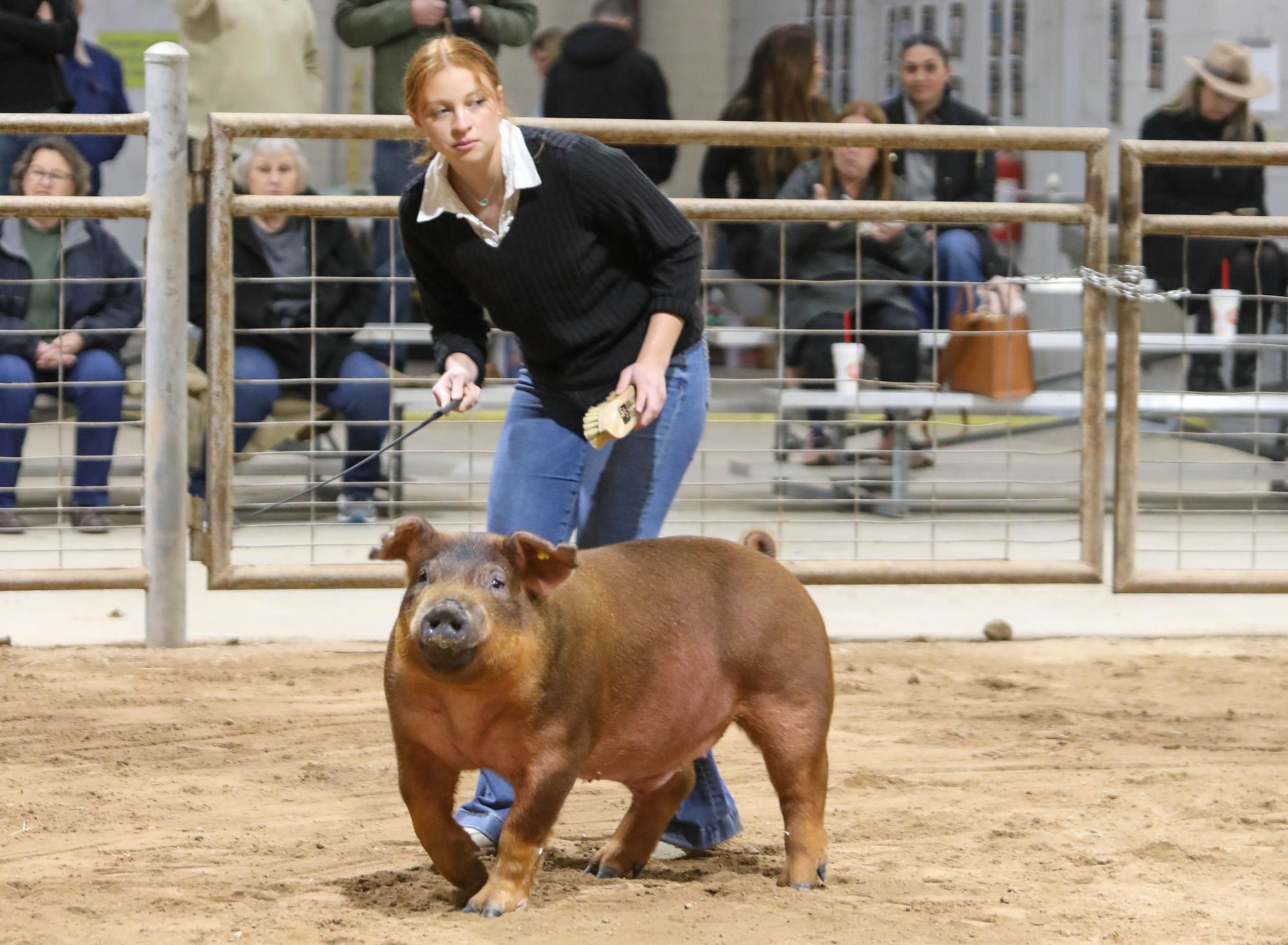
Thumps and thuds egress the ring as contestants drive goats and walk pigs. Classifications and sortation of groups based on livestock weight occur, allowing the competition to begin. All of the training, grooming, and care comes down to this moment in the ring to show off the skills the trainers and their livestock have developed. This is just one of the agricultural experiences given to FFA members.
“FFA is a career and technical student organization, and it really extends the opportunities in the classroom outside of the classroom so that students can apply their knowledge and skills outside of class,” Magan Escamilla, veterinary sciences teacher and FFA adviser said. “A lot of people make the mistake of calling it an extracurricular, but it’s really an intracurricular.”
The nationally recognized organization was founded in 1928, serving as a general umbrella in providing middle and high school students education in agriculture, business, and technology. The program supports the development of foundational knowledge, public speaking skills, and self-confidence, making students ideal candidates for the agricultural career they want to pursue. For example, junior FFA reporter Lydia Milan aspires to become a vet or go into an agriculture career.
“A lot of people think that FFA is like a farmers club, or you’re farming, but it actually helps you develop real life skills that you need,” Milan said. “A lot of those skills can be applied towards a career, teaching you responsibility and time management.”
The year-round program has many different aspects to it, with some students owning livestock as part of their supervised agricultural experience. In order to get the livestock of their choosing, students must pay for it on their own account. It becomes their responsibility to feed it every day, morning and night. The students are responsible for its medical care and maintenance throughout the entire growing season in order to compete with it in the livestock shows. Some shows include the Travis County Youth Show, the Greater Leander FFA Show, and the San Antonio Livestock Show.
“I personally do have a pig, and his name is Hank Williams Jr., and he’s a breed called a dark cross,” junior Layla Tydeman said. “What I do with him is attend the two major livestock shows, and work with my pig for around six months. What I’m trying to do is build him to where he can be muscular and structurally correct, while learning those traits that I need in life like responsibility and time management.”
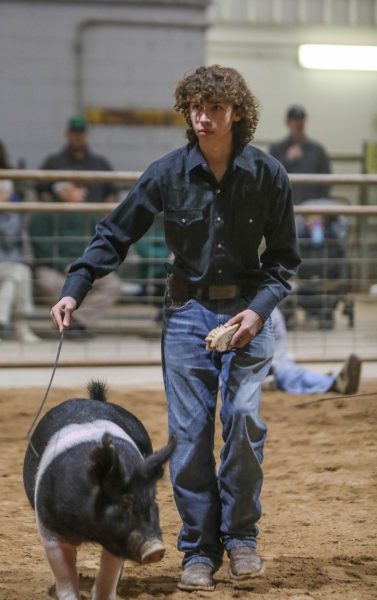
In order to be in the organization, students must be in an agriculture class and then choose to be in FFA. Since the classes are open to all students, any grade level is welcome to be a part of the organization. With the ability to be under the instruction of advisers Shannon Tidwell, Joseph Lemmons, William Albert, and Escamilla, students can hone in on the different aspects of agriculture. These classes include veterinary science, small animal management, mechanics & metal tech, principles of agriculture, floral design, and more.
“I would say [FFA] is a national organization focused on agricultural education and leadership development for students,” sophomore sentinel Kolton Kirk said. “It was established to support students who are interested in agriculture and related fields, providing them with opportunities to learn about farming, leadership, and community service.”
Other branches that make up the agriculture experience include Leadership Development Events (LDE’s) and Career Development Events (CDE’s). These events serve different purposes, with LDE’s being in the first semester, meant to help enhance participants’ public speaking, decision making, and communication, rather than just technical agriculture skills. CDE’s serve to further deepen the knowledge learned in the agriculture classes by testing their technical, leadership, and teamwork skills.
“Right now in the spring, we have students exhibiting livestock, which is a huge part of our program, but not the biggest part,” Escamilla said. “The biggest is going to be our competitive events like our CDE’s, such as vet science, floriculture, wildlife, Environmental and Natural Resources), and horse judging.”
Besides helping students with their public relations, members also learn to overcome their personal challenges such as anxiety and public speaking through FFA. The program’s effectiveness is not only reflected in the number of students going into animal science and agricultural careers.
“FFA has definitely taught me confidence because since I did compete in public speaking, I was able to learn to have confidence in myself and what I’m saying,” Tydeman said. “Adding on to that, I also learned how to communicate more effectively because it leads you to communicate with people, talk to other people, and get[s] out of your comfort zone.”
In the core of it all, the organization always makes the effort to follow and abide by their FFA creed and FFA motto. The creed was written in 1928 by Erwin Milton Tiffany as a rite of passage where FFA members would promise to follow the core values of citizenship and patriotism, with the creed starting with “I believe”. The motto on the other hand, plays a similar role but is more of what students apply when using and developing their gained agricultural skills. These standards are reflected in their motto of “Learning to Do, Doing to Learn, Earning to Live, Living to Serve.”
“[The motto] is something that you promise to do when you’re in the club or when you’re competing, or at the livestock show, or anything associated with the organization,” Milan said. “As a member, you have to live by those guidelines and present yourself accordingly.”